looking back on the past five weeks is a blur. So much has been accomplished in so little time. I think the the main aspect that has stood out to me is what teachers expect of you. A lot more than last year to say the least. I love it and I think it puts pressure on the students to produce higher quality work, and in return we get freedom and respect. Respect as in teachers really do value our opinion; whether it is choosing people for jobs in our play, or just grading ourselves, our opinion is valued.
To be honest, I really did not think we would start reading Hamlet before a novel. No specific reasons, just the fact that novels haven't really come up yet. although it has been a surprising first semester, I have stretched the limits of thinking while reading "A Raisin in the Sun". This play made me think about two very different things, dialect and suffering. The dialect of the dialog really made me acknowledge and thing about how realistic it made the play. It was not by any means our version of correct English, but it made perfect sense to me. I started to ponder on why grammar in speaking is so important i can clearly understand what a person is saying in that dialect. Then I started to think about suffering; what my idea is of suffering compared to what the characters idea of suffering is. two totally different ends of the spectrum but we both feel the same altitude of pain. Why is this? I started to wonder. I haven't come to a conclusion on either of the two but I'll let you know when I do.
It is hard to really notice anything about my growth as a writer in such a short period of time. That being said, I have realized how important the process of writing is. outline, first draft, critique x5, final draft, all play pivotal roles in a great writing piece. I think my goals revolve around my writing skills. Over the next month I wish to become more open to critique to whomever is willing to critique it. As for a plan, I will stay in office hours to get my worked critiqued by you, Randy, also my peers, and family members (really whoever I can find, every opinion matters).
Thursday, September 29, 2011

Tuesday, September 27, 2011
Blog: 9
I find it interesting that there is rarely a setting clearly described, yet most of us can depict what is going on in each scene. I am not one of these people, and I find that this is a rare aspect in a play. There is almost no setting being clearly described in each scene. Instead lies dialogue. This to me is one of the most intriguing aspects that a play can have, the setting. In Hamlet there is practically no setting.

Act one Scene one: Horatio and friends see the ghost for the first time ( horatio in disbelief).
 Act 1 Scene 5 Hamlet finds out about the ghost and his fathers death (what really happened).

Act two scene two: Polonius showing king and queen the love letters from Hamlet to Ophelia. This scene is important because polonius wants to prove how mad with love and other things Hamlet is and proposes to spy on Hamlet
Act one Scene one: Horatio and friends see the ghost for the first time ( horatio in disbelief).
Act 1 Scene 5 Hamlet finds out about the ghost and his fathers death (what really happened).Act two scene two: Polonius showing king and queen the love letters from Hamlet to Ophelia. This scene is important because polonius wants to prove how mad with love and other things Hamlet is and proposes to spy on Hamlet
Thursday, September 22, 2011
Blog: 8
As many American Icons as there are, most of our class, surprisingly, chose personal relationships as their Icons. I would have thought most of us pick famous authors or actors, but I was wrong. Not necessarily a bad surprise, but an interesting surprise. I think what really stood out to me about this project was how long the thought process was to choosing an icon. I had thought about family members, musicians, actors, for a long time before I realized it was Dr. Seuss. My usual outline takes a day at most, but I found myself re-writing my outline multiple times to fit what I was thinking.
My time was spent mainly on thinking of an Icon that fit me. When I had finally come to a conclusion, I felt satisfied; I was ready to write and keep on writing. My overall experience had its ups and downs, a learning process that will help me in future projects. I learned to not let my editor hold back on his/her opinions when revising my work; it doesn't help anyone to give nice and only positive feedback. Although I have my skepticism about my paper and other peer's work, I am excited to see it all in a book.
I am terrified yet ecstatic about this book. Terrified, for the criticism by the common folk who read the book. terrified of making a critical mistake in the editing process that will be visible for the public to see. This is also the first time that my writing will actually be heard (or read) by other people. I am not just writing for a teacher, I am writing for myself and for others as well. I am excited to show my parents that I am doing something productive when they leave for three weeks and come home to see. I am honestly excited to brag that, my work is published and in a book on The Kindle or an Ebook. So a mix of feelings really, that are fighting and conflicting as to how I should approach this, but being excited has the edge.
My time was spent mainly on thinking of an Icon that fit me. When I had finally come to a conclusion, I felt satisfied; I was ready to write and keep on writing. My overall experience had its ups and downs, a learning process that will help me in future projects. I learned to not let my editor hold back on his/her opinions when revising my work; it doesn't help anyone to give nice and only positive feedback. Although I have my skepticism about my paper and other peer's work, I am excited to see it all in a book.
I am terrified yet ecstatic about this book. Terrified, for the criticism by the common folk who read the book. terrified of making a critical mistake in the editing process that will be visible for the public to see. This is also the first time that my writing will actually be heard (or read) by other people. I am not just writing for a teacher, I am writing for myself and for others as well. I am excited to show my parents that I am doing something productive when they leave for three weeks and come home to see. I am honestly excited to brag that, my work is published and in a book on The Kindle or an Ebook. So a mix of feelings really, that are fighting and conflicting as to how I should approach this, but being excited has the edge.
Tuesday, September 20, 2011
Blog 7
I thought some of the best work came from the students that I know edited the most. For instance; Danielle Weiss's Artist statement was truly gripping, but it wasn't at its final stage until the last draft. She must have revised it 6 or 7 times with teachers and students including myself to really make a powerful piece. This gave her an edge as well as different perspectives. I definitely want to follow in her footsteps as well as anyone who got extensive help from the teacher. I will take advantage of that next time
Here is her blog: http://daniellewhumanities2011.blogspot.com/
I also thought the loop method worked very well for some people including Naxiely's paper. She created an anecdote that was very relate-able to the reader. The body paragraphs had depth but the end really brought the paper back to the initial anecdote with great flow.
http://humanitiesforjunioryear.blogspot.com/
Here is her blog: http://daniellewhumanities2011.blogspot.com/
I also thought the loop method worked very well for some people including Naxiely's paper. She created an anecdote that was very relate-able to the reader. The body paragraphs had depth but the end really brought the paper back to the initial anecdote with great flow.
http://humanitiesforjunioryear.blogspot.com/
Friday, September 16, 2011
Blog 6

I Speak For the Truffula Trees
Noah Breslauer
As a four year-old, brushing my teeth was not my favorite activity. I whined, screamed, and rebelled as much as I could, but when my mother said, “Brush… or no Dr. Seuss”, I instantly caved. Brushing turned into a relay race that I constructed as I aimed for a faster time every night just to gaze at the book for a brief moment longer before my lights went out. I studied the books, stared at the mesmerizing art, and after a while the pages in a way started to become reality. I was in the books, a blade of grass perhaps, that watched it all go by. The most popular book that put me to sleep was The Lorax. This was ironic as I soon realized because the book is somewhat depressing; a company cuts down trees and uses their products for money. The end of the book however, is uplifting, as the Lorax, the creature that protected the trees, passes on the seed of the truffula tree to a young boy. It left me in deep thought that turned into a deeper slumber.
Dr. Seuss was a nonconformist, a real maverick. He had his own ideas, his own life that he made for himself. In his hometown of Springfield, Massachusetts everyone was in a family business; some owned jewelry stores, while others managed family restaurants. His family owned a local brewery, but he had no interest. After graduating high school he attended Dartmouth University and later moved on to creating political cartoons for The U.S. government during World War Two, but ended his career as the author we know today. He had created a substantial revolution in writing. Wild animation and settings in these books created a fantasy land that children could become lost in. On the opposite side of the spectrum, the lessons as well as the social justice issues that he brought up, some of them very mature were not what you would think of as a children’s book. His genius to me was creating books and stories that could resonate with adults and children. Although I realize most people do not think a whole lot after reading Dr. Seuss’ books, as I have grown up I have noticed many people use his writing style to create rhythm. I have also noticed in my own life that I recall his books when facing a moral or ethical issue.
Dr. Seuss had a way of getting inside of my head; the way he wrote, the cartoons that he created, made me think about life at young age. I started with thinking simply about the book, not my analysis in any way, but re-experiencing and replaying the stories in my head. The thoughts later evolved into social justice including; food ethics, bullying, homelessness, and even water conservation. The stories he created are so iconic to our idea of basic morality and ethics, but yet so many people aren’t moral or ethical. What I realize now is that he tried to bring back these morals into our daily lives and into our kids’ lives. At a young age the brain is like a sponge, it absorbs ideas and concepts and usually doesn’t let them go. The morals that were used in every one of his books were engraved into my brain and I still hold them intact to this day.
Tuesday, September 13, 2011
Blog 5
1) The loop method has benefited me in my writing in a couple key ways. I reversed my intro and turned it into an anecdote. I feel that it has really helped bring a relative story, that many have gone through, and gave vivid details to connect with the reader. I tried to "write to the depth of the reader" in the body paragraph when I started to talk about Dr. Seuss' early life. although, I do think I can make the outro a bit more interesting and bring it back to the intro.
2)I would like my editor to focus on my final paragraph as I think it needs more of a statement to really leave a message to the reader. Also I would like my editor to try to cut down the biography of Dr. Seuss.
3)There is a long list of things that I would like to work on as a writer. The top two virtues that I am striving for at the moment are to be a more elegant writer as well as a more powerful writer. What I mean by powerful is that I want to be more persuasive and passionate writer. Going along, a writer who could convey his argument without being too abrupt.
2)I would like my editor to focus on my final paragraph as I think it needs more of a statement to really leave a message to the reader. Also I would like my editor to try to cut down the biography of Dr. Seuss.
3)There is a long list of things that I would like to work on as a writer. The top two virtues that I am striving for at the moment are to be a more elegant writer as well as a more powerful writer. What I mean by powerful is that I want to be more persuasive and passionate writer. Going along, a writer who could convey his argument without being too abrupt.
Thursday, September 8, 2011
4th Blog Entry
Icon 1: The lorax
1.
2.
a. "I am the Lorax. I speak for the trees. I speak for the trees, for the trees have no tongues. And I'm asking you sir, at the top of my lungs - that thing! That horrible thing that I see! What's that thing you've made out of my truffula tree?"-Lorax
b. " They say I'm old-fashioned, and live in the past, but sometimes I think progress progresses too fast!"-Lorax
c. Emma Marris described the Lorax character as a "parody of a misanthropic ecologist". She called the book "gloomy" and doubted it was good for young children. Nevertheless, she praised the book overall, and especially Seuss for understanding "the limits of gloom and doom" environmentalism.- Wikipedia
3. I could possibly add the quotes that I found as well as add a critic's point of view on the book and how I do and don't relate. maybe directly relate the story of the Lorax to my moral and ethical portion of my artist statement.
4.
a. http://en.wikipedia.org/wiki/The_Lorax
b. http://www.catinthehat.org/history.htm
c. http://greenopolis.com/goblog/green-groove/lorax-dr-seuss-introduces-children-environmental-issues
Icon 2: David Sedaris
1. http://www.youtube.com/watch?v=94A245q7O4Q
2.
a. "I'm the most important person in the lives of almost everyone I know and a good number of the people I've never even met."
b. "Often I'd take out my magnifying glass and stare into the chaos that was her face."
c. interview:
What was the piece you were doing for Esquire?
It was the first thing I did for them. I didn't think it was that successful, because I felt really responsible for the people who worked there [in the morgue]. They were all really excited about the article coming out, so I had to be a reporter. But also I kept thinking what they would think when it came out, so I couldn't repeat a lot of the things that they had said, because it would make them sound insensitive.
3. How dr. seuss really got me into storytelling and how it can be one of the biggest joys to listen to and read about. David Sedaris is one of my favorite storytellers and authors.
4.
a. http://januarymagazine.com/profiles/sedaris.html
b. http://www.barclayagency.com/sedaris.html
c. http://literati.net/Sedaris/
1.
2.
a. "I am the Lorax. I speak for the trees. I speak for the trees, for the trees have no tongues. And I'm asking you sir, at the top of my lungs - that thing! That horrible thing that I see! What's that thing you've made out of my truffula tree?"-Lorax
b. " They say I'm old-fashioned, and live in the past, but sometimes I think progress progresses too fast!"-Lorax
c. Emma Marris described the Lorax character as a "parody of a misanthropic ecologist". She called the book "gloomy" and doubted it was good for young children. Nevertheless, she praised the book overall, and especially Seuss for understanding "the limits of gloom and doom" environmentalism.- Wikipedia
3. I could possibly add the quotes that I found as well as add a critic's point of view on the book and how I do and don't relate. maybe directly relate the story of the Lorax to my moral and ethical portion of my artist statement.
4.
a. http://en.wikipedia.org/wiki/The_Lorax
b. http://www.catinthehat.org/history.htm
c. http://greenopolis.com/goblog/green-groove/lorax-dr-seuss-introduces-children-environmental-issues
Icon 2: David Sedaris
1. http://www.youtube.com/watch?v=94A245q7O4Q
2.
a. "I'm the most important person in the lives of almost everyone I know and a good number of the people I've never even met."
b. "Often I'd take out my magnifying glass and stare into the chaos that was her face."
c. interview:
What was the piece you were doing for Esquire?
It was the first thing I did for them. I didn't think it was that successful, because I felt really responsible for the people who worked there [in the morgue]. They were all really excited about the article coming out, so I had to be a reporter. But also I kept thinking what they would think when it came out, so I couldn't repeat a lot of the things that they had said, because it would make them sound insensitive.
3. How dr. seuss really got me into storytelling and how it can be one of the biggest joys to listen to and read about. David Sedaris is one of my favorite storytellers and authors.
4.
a. http://januarymagazine.com/profiles/sedaris.html
b. http://www.barclayagency.com/sedaris.html
c. http://literati.net/Sedaris/
Tuesday, September 6, 2011
Blog 3
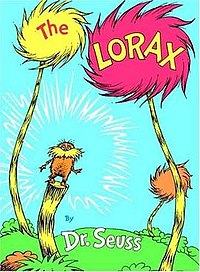
Icon 1: The lorax
1.
2.
a. "I am the Lorax. I speak for the trees. I speak for the trees, for the trees have no tongues. And I'm asking you sir, at the top of my lungs - that thing! That horrible thing that I see! What's that thing you've made out of my truffula tree?"-Lorax
b. " They say I'm old-fashioned, and live in the past, but sometimes I think progress progresses too fast!"-Lorax
c. Emma Marris described the Lorax character as a "parody of a misanthropic ecologist". She called the book "gloomy" and doubted it was good for young children. Nevertheless, she praised the book overall, and especially Seuss for understanding "the limits of gloom and doom" environmentalism.- Wikipedia
3.
I could possibly add the quotes that I found as well as add a critic's point of view on the book and how I do and don't relate.
maybe directly relate the story of the Lorax to my moral and ethical portion of my artist statement.
4.
a. http://en.wikipedia.org/wiki/The_Lorax
b. http://www.catinthehat.org/history.htm
c. http://greenopolis.com/goblog/green-groove/lorax-dr-seuss-introduces-children-environmental-issues
Icon 2: David Sedaris
1. http://www.youtube.com/watch?v=94A245q7O4Q
2.
a. "I'm the most important person in the lives of almost everyone I know and a good number of the people I've never even met."
b. "Often I'd take out my magnifying glass and stare into the chaos that was her face."
c. interview:
3. How dr. seuss really got me into storytelling and how it can be one of the biggest joys to listen to and read about. David Sedaris is one of my favorite storytellers and authors.
4.
a. http://januarymagazine.com/profiles/sedaris.html
b. http://www.barclayagency.com/sedaris.html
c. http://literati.net/Sedaris/
2.
a. "I am the Lorax. I speak for the trees. I speak for the trees, for the trees have no tongues. And I'm asking you sir, at the top of my lungs - that thing! That horrible thing that I see! What's that thing you've made out of my truffula tree?"-Lorax
b. " They say I'm old-fashioned, and live in the past, but sometimes I think progress progresses too fast!"-Lorax
c. Emma Marris described the Lorax character as a "parody of a misanthropic ecologist". She called the book "gloomy" and doubted it was good for young children. Nevertheless, she praised the book overall, and especially Seuss for understanding "the limits of gloom and doom" environmentalism.- Wikipedia
3.
I could possibly add the quotes that I found as well as add a critic's point of view on the book and how I do and don't relate.
maybe directly relate the story of the Lorax to my moral and ethical portion of my artist statement.
4.
a. http://en.wikipedia.org/wiki/The_Lorax
b. http://www.catinthehat.org/history.htm
c. http://greenopolis.com/goblog/green-groove/lorax-dr-seuss-introduces-children-environmental-issues
Icon 2: David Sedaris
1. http://www.youtube.com/watch?v=94A245q7O4Q
2.
a. "I'm the most important person in the lives of almost everyone I know and a good number of the people I've never even met."
b. "Often I'd take out my magnifying glass and stare into the chaos that was her face."
c. interview:
What was the piece you were doing for Esquire?
It was the first thing I did for them. I didn't think it was that successful, because I felt really responsible for the people who worked there [in the morgue]. They were all really excited about the article coming out, so I had to be a reporter. But also I kept thinking what they would think when it came out, so I couldn't repeat a lot of the things that they had said, because it would make them sound insensitive.3. How dr. seuss really got me into storytelling and how it can be one of the biggest joys to listen to and read about. David Sedaris is one of my favorite storytellers and authors.
4.
a. http://januarymagazine.com/profiles/sedaris.html
b. http://www.barclayagency.com/sedaris.html
c. http://literati.net/Sedaris/
Subscribe to:
Posts (Atom)